Planning a storage rack system for warehouse management starts with one idea: every item needs a fixed, named home. Software, spreadsheets and stock lists can only be as accurate as the shelves they describe. If items have no fixed home, pickers search, counts drift and space fills up without anyone noticing. This guide explains how racking supports each step of managing stock, which rack type fits which kind of goods, and how to set up and label shelving so it stays organised.
A storage rack system supports warehouse management by giving every item a fixed, labelled place. That makes receiving, put-away, picking and stock counts faster and more accurate. Choose the rack by how goods move: pallet racking suits forklift and pallet loads, while boltless shelving suits cartons, bins and items picked by hand.
What is a storage rack system in a warehouse?
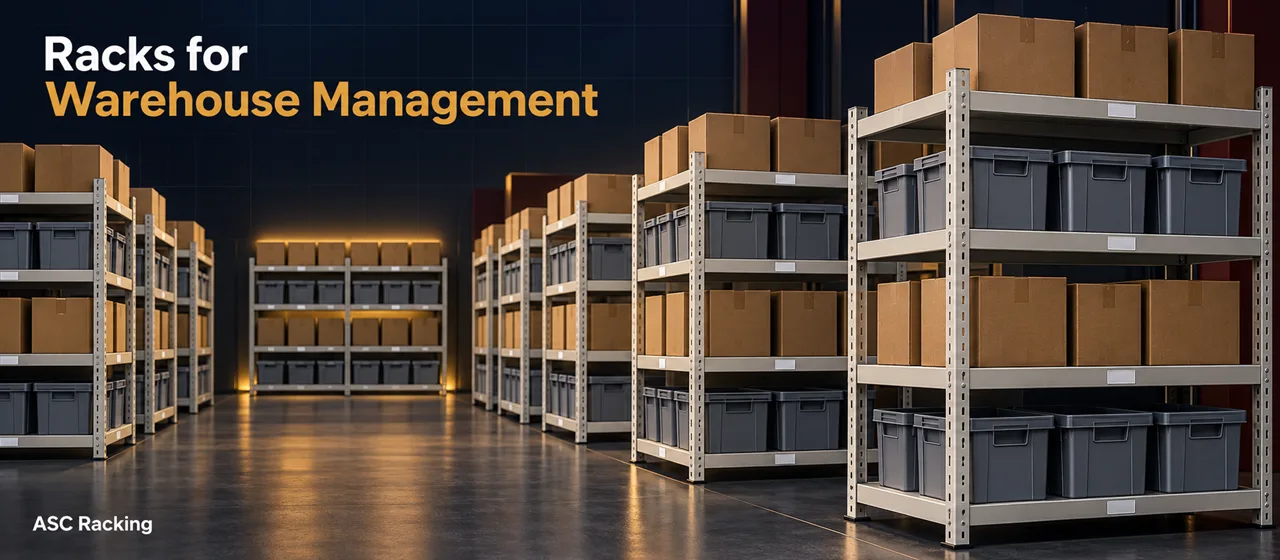
A storage rack system is a set of upright frames with shelves or beams that holds goods off the floor in fixed positions. It uses the height of the room, keeps aisles clear and gives each item a place that can be named and found again.
There is no single “warehouse rack”. A storeroom that keeps cartons, spare parts and supplies needs something very different from a distribution centre that moves full pallets by forklift. Getting this match right matters more than any other choice, because the rack decides how quickly and safely people can put stock away and take it out.
For a wider look at options in Singapore, see our warehouse racking system guide.
How racking supports warehouse management
Most warehouses follow the same basic flow: receive goods, put them away, pick them for orders, and count what is left. The rack system touches every one of these steps.
- Receiving: incoming stock needs a known place to go. Without spare, labelled locations, deliveries pile up in the aisle.
- Put-away: each item goes to a fixed shelf position with a code. The code is what your records point to.
- Picking: pickers go straight to the code instead of searching. Items that move often sit where they are easiest to reach.
- Stock counts: counting shelf by shelf is simple when each position holds one item. Gaps and mismatches show up quickly.
A warehouse management system (WMS) or a simple stock spreadsheet does the tracking, but it relies on the physical layout being clear and consistent. That is why fixing the shelving is often the first step before any new software.

Types of storage rack systems and when each fits
The right type depends on how goods arrive and how they are handled. The table below is a general guide to common systems. ASC Racking supplies boltless shelving racks; the other types are described for comparison only.
| Rack type | How goods are handled | Best for | Not suited to |
|---|---|---|---|
| Selective pallet racking | Pallets placed and removed by forklift | Many different pallet lines that each need direct access | Loose items picked by hand |
| Drive-in racking | Forklifts drive into the rack lanes | Large quantities of the same pallet line | Mixed stock that needs quick access to every item |
| Cantilever racking | Long items loaded from the front with no uprights in the way | Pipes, bars and timber | Boxes and small parts |
| Boltless shelving | Cartons, bins and items placed and picked by hand | Storerooms, back-of-house, spare parts, files and supplies | Full pallets moved by forklift |
If most of your stock is picked by hand, boltless shelving is usually the practical choice. Our article on boltless racking in Singapore explains how the frames lock together without bolts.

Setting up shelving for stock control
A rack only helps warehouse management if it is set up with a plan. These habits keep a shelving area organised long after installation.
Give every position a code
Use one code per shelf position that reads in the same order everywhere, for example zone, rack, then level. Put the label on the front edge of the shelf so it can be seen from the aisle, and use exactly the same code in your stock list or WMS.
Place stock by how often it moves
Keep the items you pick most often on the shelves between waist and shoulder height, closest to the packing or dispatch point. Slow movers and spare stock can go on the top level. This simple step, often called slotting, cuts walking and bending for pickers.
Keep heavy items low
Put the heaviest cartons on the lower shelves and spread weight evenly across each shelf. Never exceed the rated load on any level. Our rack loading and inspection guide covers safe loading and regular checks.
Plan for first in, first out
For stock with expiry dates or batches, load new stock behind or beside the older stock so the oldest is picked first. Leave a little space on each shelf so staff can rotate items without unloading the whole level.
What to check before ordering boltless racks
Once you know boltless shelving fits your stock, check these details against the space and the load.
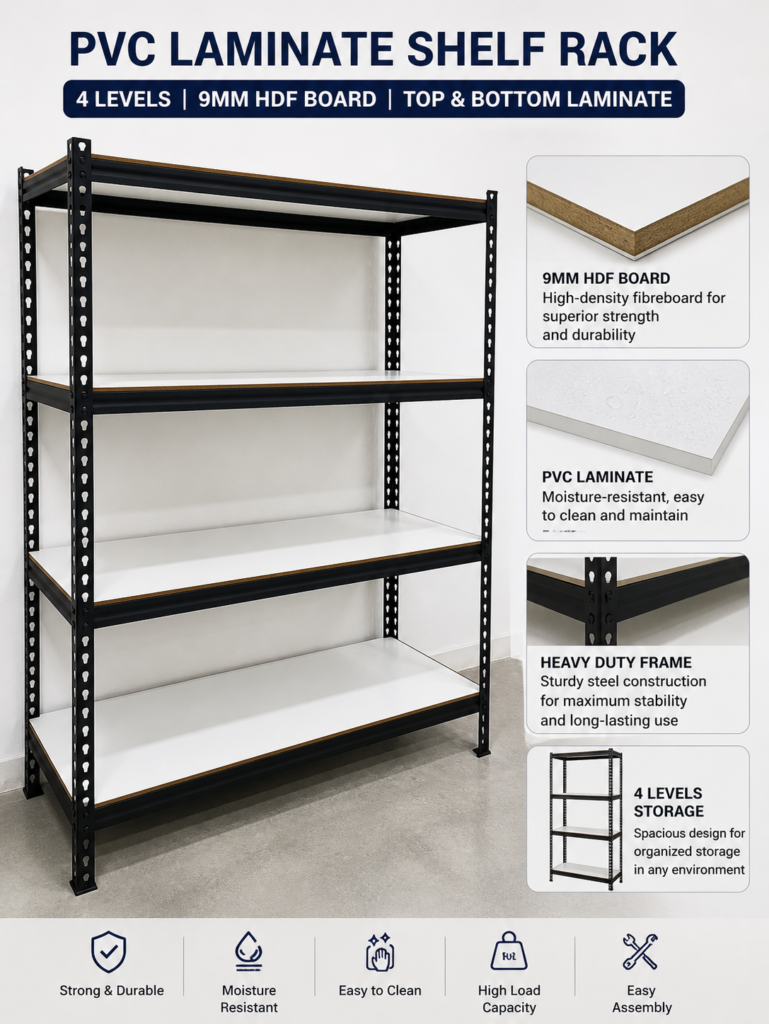
- Load per shelf: ASC lists its Full Metal (4 levels) and PVC Laminate (4 Levels) 9mm HDF Board racks at 300kg per shelf.
- Height: heights of 1840mm, 2160mm, 2440mm, 2760mm and 3000mm are offered. Taller racks use more of the ceiling height; see why rack height increases storage capacity.
- Length and depth: lengths from 600mm to 1800mm and depths of 300mm, 450mm or 600mm. Match the depth to your largest carton so nothing hangs over the edge.
- Shelf finish: full metal shelves or PVC laminated 9mm HDF boards. The PVC laminate vs full metal comparison explains the difference.
- Rust protection: the racks have an epoxy powder coating, which helps in humid storerooms.
- Layout: a single run along one wall, an L-shaped (4 x 4 levels) rack for corners, or a U-shaped (4 x 4 x 4 levels) rack across three walls.
Listed price ranges on ASC’s shop at the time of writing are $165.00 to $400.00 for Full Metal (4 levels), $145.00 to $335.00 for PVC Laminate (4 Levels), $330.00 to $890.00 for Full Metal L Shaped (4 x 4 Levels) and $495.00 to $1,455.00 for Full Metal U Shaped (4 x 4 x 4 Levels), depending on size. ASC offers free delivery across Singapore and free professional installation for its storage racks. For more help comparing options, read how to choose the right storage rack for your warehouse.
Common storage problems and the rack fix
| Problem | Likely cause | Rack fix |
|---|---|---|
| Pickers search for items | No fixed locations or labels | Code every shelf position and record it |
| Stock counts do not match records | Items stored in more than one place | One item per position; update codes when moving stock |
| Floor space runs out | Goods stacked on the floor | Use taller racks and the room’s height |
| Shelves sag or look overloaded | Weight above the shelf rating | Move heavy items low and stay within the rated load |
| Corners left empty | Straight racks only | L-shaped or U-shaped layouts |
Frequently asked questions
What is a racking system for a warehouse?
A warehouse racking system is a set of upright frames and shelves or beams that holds stock off the floor in fixed positions. Pallet racking holds loads placed by forklift, while boltless shelving holds cartons, bins and loose items that staff place and pick by hand. Each position can be labelled so stock is easy to find and count.
How does a storage rack system help warehouse management?
It gives every item a fixed, labelled home. Staff put stock away to a known location, pickers go straight to it, and counts can be done shelf by shelf. Records in a spreadsheet or warehouse management system (WMS) only stay accurate when the physical locations are clear and used the same way every time.
Is boltless shelving strong enough for a warehouse?
It depends on what you store and how you handle it. ASC lists its Full Metal (4 levels) and PVC Laminate (4 Levels) racks at 300kg per shelf, which suits cartons, bins, tools and supplies handled by hand. Goods on pallets moved by forklift need pallet racking, which is a different system.
How should I label a storage rack for stock control?
Use one code per shelf position that reads in the same order everywhere, for example zone, rack, level. Put the label on the front edge of each shelf where it can be seen from the aisle, and record the same codes in your stock list or WMS so the system and the shelf always match.
Can I change the rack layout later as stock grows?
Boltless racks go together without bolts, so shelf positions can be changed and more bays added as your range changes. ASC also offers L-shaped and U-shaped layouts that use corners and three walls. Update your location codes whenever you move a shelf so records stay correct.
Choosing a storage rack system for warehouse management
Good warehouse management starts with where stock physically sits. Match the rack type to how goods are handled, give every shelf position a code, keep fast movers within easy reach and heavy items low, and stay within the rated load. For stock that is picked by hand, boltless shelving in a single, L-shaped or U-shaped layout gives each item a fixed home your records can rely on.