Knowing how to choose the right storage rack for your warehouse saves you from two costly mistakes: buying a rack that cannot carry your stock, or buying a system built for forklifts when your team picks everything by hand. The right choice depends less on the rack and more on what goes on it, how people reach it and the space it has to fit.
To choose the right storage rack for a warehouse, start with what you store: the weight per shelf, the size of each item and how it is handled. Goods moved by forklift on pallets need pallet racking. Cartons, bins and parts picked by hand suit boltless shelving. Then match the load rating, height, depth, shelf finish and layout to your space.
This guide walks through those decisions in order, explains when boltless shelving fits and when a warehouse needs a different system, and ends with a checklist you can use before you order.
Start with what you store
Before you look at any rack, list the stock that will sit on it. Three facts decide most of the choice.
- Weight: the heaviest load a single shelf will carry, not the total for the whole rack. A shelf of spare parts can weigh far more than a shelf of packaging.
- Size and shape: cartons, plastic bins, loose items, long lengths or full pallets. Each one needs a different shelf depth or a different system.
- How it is handled: by hand or by forklift, and how often. Fast-moving stock should sit at waist to shoulder height, where staff can reach it without a ladder.
Write these down per product group. A warehouse often needs more than one answer: shelving for small parts near the packing area, and a separate system for bulk stock.
| What you store | How it is handled | Usually suits |
|---|---|---|
| Cartons, bins, tools, spare parts | By hand | Boltless shelving |
| Documents, office and retail stock | By hand | Boltless shelving with a smooth shelf finish |
| Full pallets | Forklift or pallet jack | Pallet racking |
| Long items such as pipes or timber | By hand or forklift | Cantilever racking |
Shelving or racking: which does your warehouse need?
People often use “rack” for both, but they are different systems. Boltless shelving is a freestanding unit of steel uprights and shelf panels that slot together without bolts or tools. It is built for goods that people place and pick by hand. You can read more in our guide to how boltless racking works.
Pallet racking is a structural system of tall frames and beams designed to hold pallets placed by forklift, often using the full height of the building. Cantilever racking uses arms instead of shelves, so long items can be loaded from the front. Both are specialist systems that usually involve a site survey and an engineered design.
ASC Racking supplies boltless storage racks, so this guide focuses on that part of the warehouse. If most of your stock arrives and moves on pallets, speak to a pallet racking specialist for that zone and use shelving for everything picked by hand.

Check the load rating per shelf
A load rating is stated per shelf, and it assumes the weight is spread evenly across the panel (a uniformly distributed load, or UDL). ASC groups its boltless racks into three classes:
- Light duty: up to 100kg UDL per shelf.
- Medium duty: up to 200kg UDL per shelf.
- Heavy duty: up to 300kg UDL per shelf.
Pick the class from the heaviest shelf on your list, and leave a margin rather than loading every level to its limit. A heavy item in the middle of a long shelf strains that one spot, so spread dense stock out or move it to a lower level. Our page on the heavy duty 4 tier storage rack explains load classes and safe loading in more detail. For loads beyond these classes, ASC offers custom solutions.
Measure the space: height, depth and aisles
Measure the floor area, the clear height under beams, sprinklers and lights, and the width you need for people and trolleys to pass. Then work out the rack size from those numbers, not the other way round.
- Height: a taller rack adds storage on the same floor area, as long as staff can reach the top shelf safely. ASC’s 4-level racks come in heights from 1840mm to 3000mm.
- Depth: match the depth to your largest carton or bin. Too shallow and items overhang; too deep and small items get lost at the back. Depths of 300, 450 and 600mm are available.
- Length: lengths run from 600 to 1800mm. Shorter bays suit heavy loads and narrow walls; longer bays give more continuous shelf space.
- Aisles: leave enough room for a person carrying a carton, or a trolley, to pass and turn. Keep exits, fire equipment and electrical panels clear.
See why rack height adds storage capacity for the trade-offs of going taller, and the 4-tier boltless rack sizes and prices page for every size combination ASC lists.
Choose the shelf finish
ASC’s boltless racks come with two shelf finishes, and the choice depends on where the rack stands and what touches the shelves.
| Finish | Best for | Think twice when |
|---|---|---|
| Full metal, epoxy powder coated | Warehouses, workshops, tools, parts and rough stock that is dragged on and off | You need a quiet, smooth surface for files or retail goods |
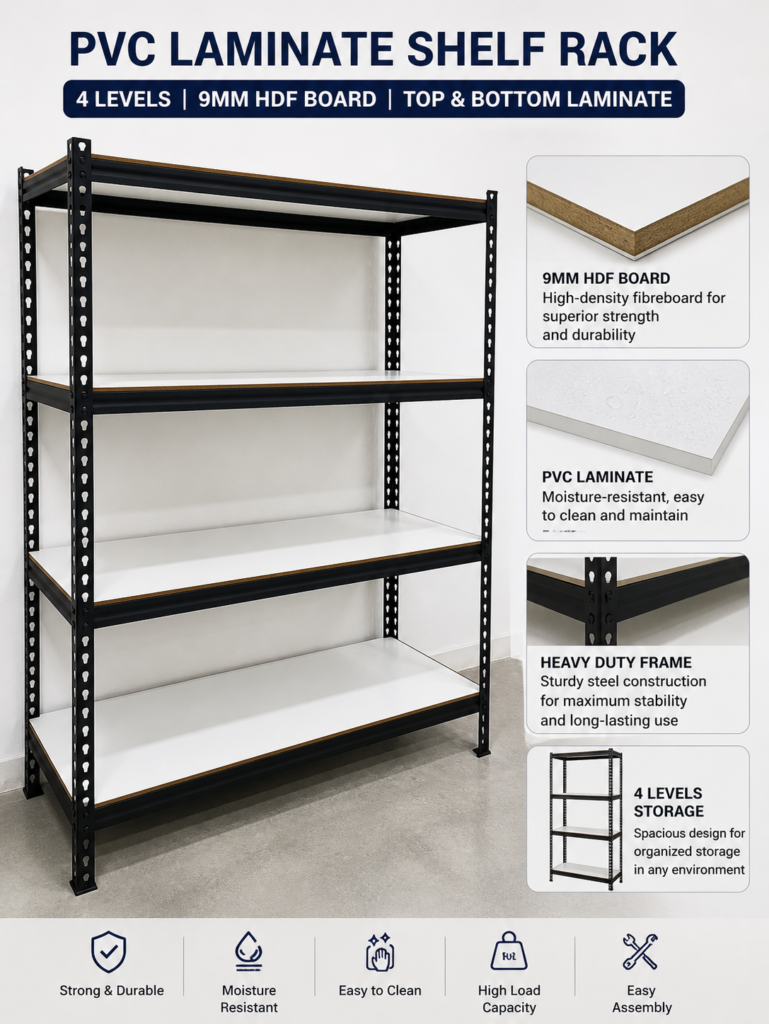
| PVC laminated 9mm HDF board | Offices, retail back rooms and storerooms where an easy-to-clean surface matters | Shelves will get wet or take sharp, heavy metal parts often |
Both carry a 300kg per shelf rating on ASC’s 4-level racks, so the decision is about the surface, not the strength. The epoxy powder coating on the frames helps them resist rust in Singapore’s humidity. Our PVC laminate vs full metal comparison goes through the differences in more depth, or browse the Full Metal (4 Levels) rack.
Pick a layout: single, L-shaped or U-shaped
Boltless racks can stand alone or join to follow the walls of a room.
- Single rack: the most flexible option. Run several in a line along a wall or back to back as an island, and move them as the warehouse changes.
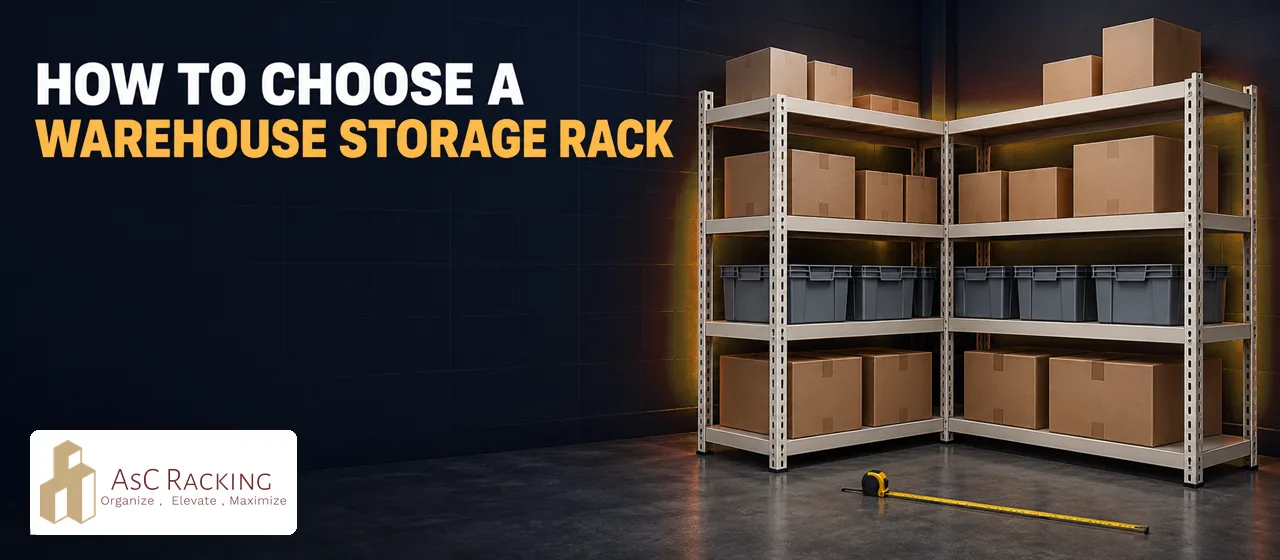
- L-shaped: two racks joined at a corner. It uses corner space that a single rack leaves empty, which helps in small storerooms and site offices.
- U-shaped: three racks around three walls, which turns a small room or bay into a walk-in store with shelving on every side.
Read single rack vs L-shaped boltless racking and our guide to U-shaped boltless racking if you are deciding between layouts. Because boltless shelves can be moved up or down later, you can also change shelf spacing as your stock changes; adjustable vs fixed shelving explains why that matters.
Plan for safety and upkeep
A rack is only as safe as the way it is loaded and looked after. A few habits keep it within its rating:
- Put the heaviest items on the lowest shelves and lighter, bulky items higher up.
- Keep every shelf within its rated load, with the weight spread across the panel.
- Stand the rack on a level floor and keep it upright; do not climb the shelves.
- Check uprights and shelves regularly for bends, dents or loose parts, and take a damaged rack out of use until it is repaired.
Our warehouse racking safety guide covers loading, inspection and maintenance step by step. For pallet racking, the design and inspection are usually handled by a racking specialist; check the requirements that apply to your site.
At ASC Racking, delivery and installation are free across Singapore, which also means the racks are set up and levelled for you.
Common mistakes when choosing a warehouse storage rack
- Buying by total capacity: a rack’s total load means little if one shelf carries most of the weight. Plan by the heaviest shelf.
- Measuring the floor but not the height: beams, sprinklers and lights limit how tall a rack can be.
- Choosing depth by guesswork: measure your largest carton or bin before you pick a depth.
- Forgetting the aisle: a full wall of shelving is no use if trolleys cannot pass.
- Using shelving for pallets: pallets moved by forklift belong on pallet racking, not on boltless shelving.
A checklist before you order
- List what you store, with the heaviest shelf load for each group.
- Decide the system: shelving for goods picked by hand, pallet racking for forklift loads.
- Pick the load class with a margin above your heaviest shelf.
- Measure the floor, clear height and aisle width.
- Choose the height, depth and length that fit those measurements.
- Choose the shelf finish and a single, L-shaped or U-shaped layout.

Frequently asked questions
What type of storage rack is best for a warehouse?
It depends on how goods are handled. Cartons, bins, tools and parts that staff pick by hand suit boltless shelving. Full pallets moved by forklift need pallet racking, and long items such as pipes suit cantilever racking. Many warehouses use more than one system, with shelving near packing areas and racking for bulk stock.
How much weight can a boltless storage rack hold?
It depends on the load class. ASC rates its light duty boltless racks at up to 100kg per shelf, medium duty at up to 200kg and heavy duty at up to 300kg, with the weight spread evenly across each shelf. Choose the class from the heaviest shelf you plan to load, and leave a margin.
What size storage rack should I choose for my warehouse?
Measure first. The clear height under beams and sprinklers sets the rack height, your largest carton or bin sets the depth, and the wall length and aisle width set the length and number of bays. ASC’s 4-level racks come in heights from 1840mm to 3000mm, depths of 300 to 600mm and lengths of 600 to 1800mm.
Is boltless shelving strong enough for warehouse use?
Yes, for goods handled by hand. ASC’s heavy duty boltless racks are rated at up to 300kg per shelf, which covers most cartons, bins, tools and spare parts. Boltless shelving is not designed for pallets placed by forklift; those loads need pallet racking built for that handling.
Should I choose a single, L-shaped or U-shaped rack?
A single rack is the most flexible and can be moved as your layout changes. An L-shaped rack uses corner space in small storerooms. A U-shaped rack lines three walls and turns a small room or bay into a walk-in store. Pick the layout from the shape of the space and how people move through it.
Choosing the right storage rack for your warehouse
Choosing the right storage rack for your warehouse comes down to four questions: what you store, how it is handled, how much each shelf must carry and how much space you have. Answer those first, and the choice of system, size, finish and layout follows. For a wider look at warehouse systems, read our warehouse racking system guide for Singapore.