You may drill into the inside of an HDB household shelter wall, to a depth of no more than 50mm, to fix inserts and removable screws. What you may not do is leave it there unconditionally: anything mounted on a shelter wall has to come off within 48 hours of being notified. Power-driven nails are not allowed on internal shelter walls at all, and the door, the door notice and the ventilation fittings must not be touched.
That is the short version of Chapter 7 of the SCDF’s Technical Requirements for Household Shelters 2023, and it is more permissive than most people expect. The common advice online is simply “you cannot drill in a bomb shelter”. That is not what the requirements say, and the real rule matters if you are deciding how to store things in there.
What a household shelter actually is
Under the Civil Defence Shelter Act 1997, new flats and houses in Singapore must include a household shelter or a storey shelter. It is a reinforced room built to protect the people inside from weapon effects such as blast and fragments during a wartime emergency, and SCDF’s own description notes that it is designed to be easily accessible and to need very little maintenance.
In peacetime it is simply a room in your flat. Most households use it for storage, which is allowed. The requirements are about not compromising the structure, the door or the ventilation that make it a shelter.
Can you drill into a bomb shelter wall?
Yes, within limits. Clause 7.2.1(g) permits drilling into the internal face of shelter walls and ceiling slabs to a depth of not more than 50mm, to fix inserts and removable screws. Pictures, posters, cabinets and shelves are named as the kinds of fixtures this covers. There is no restriction on the diameter of a non-metallic insert, provided it is not longer than 50mm, and SCDF states that ensuring the insert is strong enough for its purpose is the owner’s responsibility.
The condition attached to that permission is the part people miss. The same clause says fixtures on the internal face of shelter walls must be removed by the owner within 48 hours upon notification. A drilled-in shelving system is therefore allowed, but you are agreeing to take it down at short notice if you are asked to.
Power-driven nails are a separate matter. Clause 7.2.1(h) permits them only on the external face of shelter walls, and Clause 7.2.2(e) lists fixings using power-driven nails into internal shelter walls among the works that are not permitted.
What is not permitted
Clause 7.2.2 sets out the works that are not allowed inside a household shelter. The ones that come up most often in a home are:
- Hacking or drilling beyond what Clause 7.2.1 permits — walls, floor slabs and ceiling slabs.
- Power-driven nail fixings into internal shelter walls.
- Modifying, changing, removing or tampering with the shelter door in any way.
- Tampering with, removing or covering the door notice. SCDF’s reasoning is that the notice carries information the occupants need when the shelter is actually in use.
- Modifying or tampering with the ventilation openings, their plates, or the bolts and nuts that hold them.
- Wall tiles, rock stone finish, cement sand finish or gypsum plastering on the internal faces of the shelter walls.
- Installing cornices inside the shelter.
- A second layer of floor or skirting tiles, and floor tiles laid with adhesive rather than wet cement mortar.
The ventilation openings, and the 25% rule
You are allowed to cover the ventilation openings with removable aesthetic or architectural finishes, but Clause 7.2.1(j) requires that at least 25% of the total area of the two openings is left uncovered during peacetime. In practice this is the rule most often broken by accident: a rack pushed flat against the wrong wall, or a stack of boxes to the ceiling, can block a sleeve without anyone intending to.
It is worth checking where your two openings are before you decide which wall the storage goes on.
Painting the shelter
Painting the walls, ceiling and door is permitted under Clause 7.2.1(e). Three conditions come with it: the door notice, locking bolts and door seal must not be painted over; old paint should be removed before repainting so the coat does not thicken to the point where the door binds; and the new coat must be completely dry before the door is closed, or the door and rubber gasket can stick to the frame.
What this means for storing things in there
The rules do not stop you using the shelter as a store room. They shape how the storage should be built.
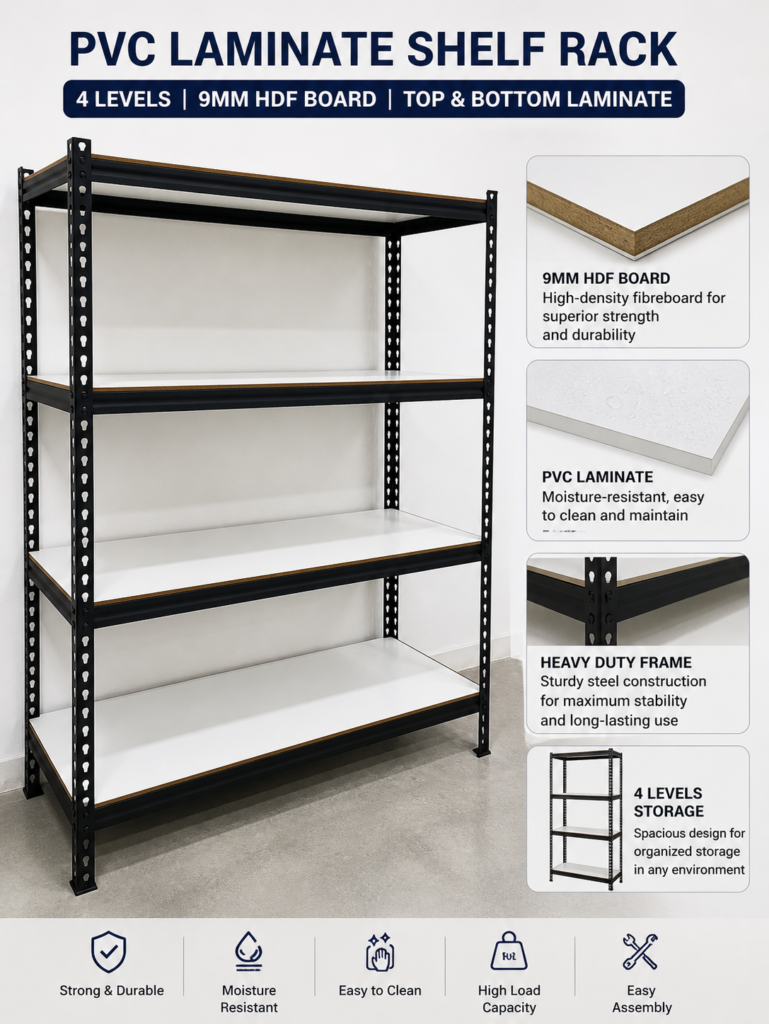
A fixed, drilled-in carpentry build is permitted, but it carries the 48-hour removal obligation and it commits you to holes in a wall you cannot hack or make good in the usual way. A freestanding rack avoids that entirely: nothing is fixed to the wall, so there is nothing to remove on notification, and the shelter structure is untouched.
That is the reason boltless racks are the common answer for household shelters. They stand on their own, they can be built to the room’s exact dimensions, and they can be taken apart and moved without leaving anything behind.
Be careful of “SCDF-approved” claims
SCDF states plainly on its own website that it does not endorse or certify products, and that claims of “SCDF-approved” or similar are false. If a supplier tells you their rack, door or shelter fitting is approved or certified by SCDF, that claim is not true — whatever else may be true about the product.
There is no approval to look for. What matters is whether the installation stays within Clause 7.2: nothing drilled deeper than 50mm, no power-driven nails inside, the door and its notice untouched, and the ventilation openings at least a quarter clear.
Frequently asked questions
Can I put shelves in my bomb shelter?
Yes. Shelves are named in Clause 7.2.1(g) as a permitted fixture on the internal face of a shelter wall, subject to the 50mm drilling depth and the 48-hour removal condition. A freestanding rack needs no drilling and so falls outside that condition altogether.
Can I remove the bomb shelter door to save space?
No. Modifying, changing, removing or tampering with the shelter door is listed under Clause 7.2.2 as not permitted.
Can I cover the ventilation openings?
Only partially. Removable finishes may cover them provided at least 25% of the combined area of the two openings stays uncovered during peacetime.
Can I tile the inside of the shelter?
Floor tiles bonded with wet cement mortar are permitted, with floor finishes and screed no more than 50mm thick in total, as are skirting tiles up to 100mm high and vinyl or linoleum flooring. Wall tiles on the internal faces are not permitted.
Do I need approval before putting a rack in?
No approval process exists for storage inside a household shelter, and SCDF does not certify products. The obligation is simply to stay within the permitted works in Clause 7.2.
Where to read the requirements yourself
The full document is published by SCDF as the Technical Requirements for Household Shelters 2023. Chapter 7 is the chapter on permitted and not permitted works; Clause 7.2 is the one that governs everything above. If you are planning anything beyond storage, read it rather than relying on a summary, including this one.
If what you want is simply to use the room properly, our made-to-measure HDB bomb shelter racks are built to the shelter’s exact dimensions and stand freely, so nothing is drilled into the walls.