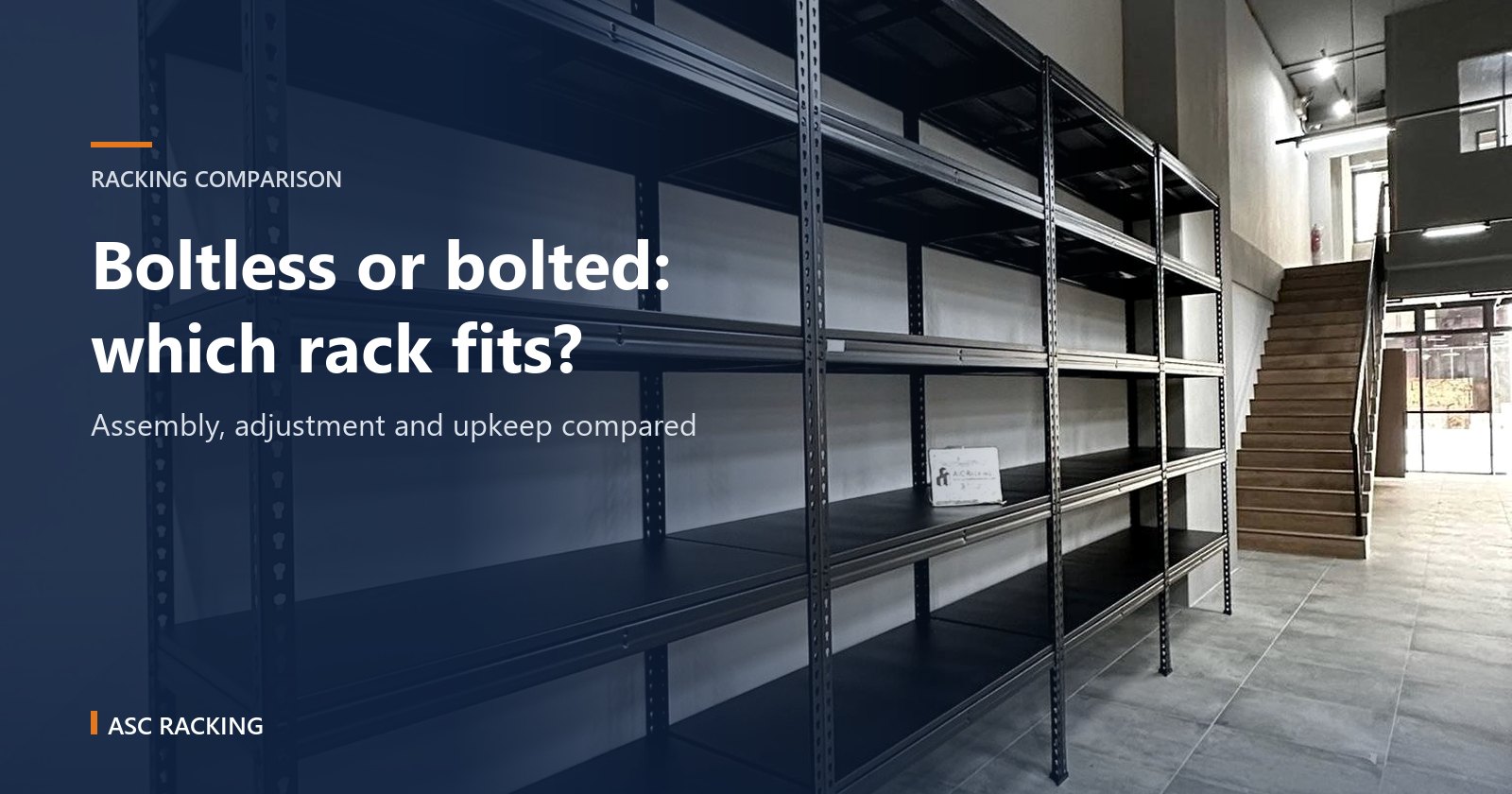
Boltless vs bolted racking comes down to how the frame is joined. A boltless rack locks together with rivet heads on the beams that drop into keyhole slots on the uprights, so it goes up without tools and the shelf levels can be moved later. A bolted rack is held together with nuts and bolts, which takes longer to build and change but suits fixed, heavy or forklift-served storage once it has been engineered for that job. For most Singapore homes, storerooms, offices and small warehouses that are loaded by hand, boltless racking does the job. Bolted or structural racking earns its place when loads go on pallets or the rack has to be designed and certified for a specific site.
This guide is written by a boltless rack supplier, so we will say plainly where our product is the wrong choice.
In short
- Boltless racks lock together by hand (a rubber mallet helps), are easy to adjust, and suit shelving loaded by people rather than machines.
- “Bolted” covers several different things: slotted angle shelving, bolted shelving units and structural pallet racking. Compare like with like.
- Read load ratings per level and as a uniformly distributed load (UDL). A 300 kg rating assumes the weight is spread across the shelf, not parked in the middle.
- If staff use the rack at work, MOM expects it to be designed for the intended load, with its safe working load displayed, a risk assessment done and regular checks for damage.
How boltless racking works
A boltless rack has three main parts: upright posts punched with rows of keyhole slots, beams with rivet heads at each end, and shelf boards that sit on the beams. You hook the beam rivets into the slots at the height you want and tap them down until they seat. The weight of the shelf and its load pulls the joint tighter. There are no loose nuts to lose and no spanner work.
Moving a level is the reverse: lift the beam out, hook it in higher or lower, then push up hard under each end. If it lifts, it was not fully down. That is why boltless racking is popular in storerooms where the contents change every few months, from Chinese New Year decorations to stock for a December sale. If you want the longer explanation of parts and uses, our guide to boltless racking in Singapore covers it in detail.
At ASC Racking our racks use steel frames with an epoxy powder coating against rust, which matters in a humid storeroom or service yard. Shelves come as either full metal panels or 9mm HDF board with PVC laminate.
What counts as bolted racking
This is where many comparisons online go wrong. “Bolted” is not one product. In Singapore you will usually meet three kinds:
- Slotted angle shelving. L-section steel angles punched with slots, joined with nuts and bolts at every corner. Cheap, flexible in shape, slow to build and slow to change.
- Bolted shelving units. Shelf panels bolted to posts, common in older offices and archives. Tidy once built, but each level is a small dismantling job.
- Structural or pallet racking. Heavy frames and beams sized for pallets and forklifts, usually anchored to the floor and designed for the site. Beam connections on many modern pallet systems actually hook in too, with a safety pin or lock, so the defining feature is the engineering, not the bolt.
When someone asks whether boltless or bolted is stronger, the honest answer depends on which of these they mean. A boltless rack built for hand loading is quicker to put up and adjust than a light slotted angle unit, but it is not a substitute for pallet racking.
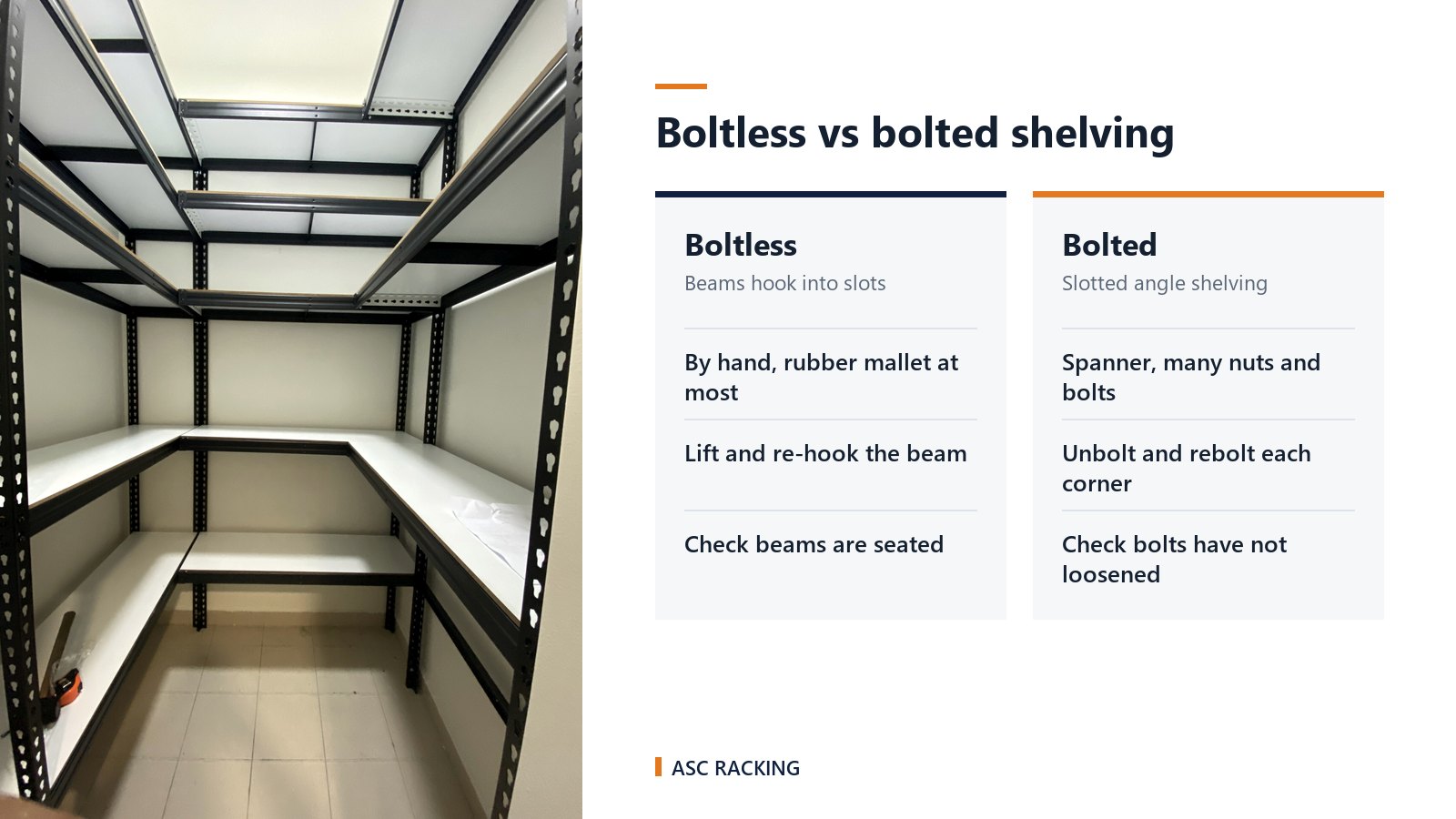
Boltless vs bolted racking compared
The table below compares boltless shelving with the two bolted types most people are actually choosing between. Pallet racking is listed separately because it solves a different problem.
| Factor | Boltless racking | Slotted angle / bolted shelving | Structural pallet racking |
|---|---|---|---|
| Assembly | By hand, rubber mallet at most | Spanner and many nuts and bolts | Installer crew, floor anchors, often a lift |
| Changing shelf heights | Lift and re-hook the beam | Unbolt and rebolt each corner | Possible, but load ratings must be rechecked |
| Typical loading | By hand: cartons, tubs, files, tools | By hand: light parts, files | Pallets by forklift or reach truck |
| Maintenance | Check beams are seated and not bent | Check bolts have not worked loose | Formal inspection regime, damage reporting |
| Moving house or premises | Knocks down and rebuilds quickly | Slow; bolts and nuts go missing | Specialist dismantling and redesign |
| Best fit | Homes, HDB storerooms, offices, shop backrooms, small warehouses | Budget, rarely changed light storage | Distribution centres and bulk pallet storage |
Load ratings: what 300 kg per level really means
Our Full Metal and PVC Laminate 4-level racks are listed at 300 kg per shelf, and our FAQ explains the general tiers we work to: up to 100 kg UDL per shelf for light duty, up to 200 kg for medium duty and up to 300 kg for heavy duty. Two words in there do most of the work.
Per shelf means each level, not the whole rack. UDL means uniformly distributed load: the weight spread evenly along the beams. Ratings from any supplier, boltless or bolted, assume this.
A worked example. Say you store cartons of stock weighing about 20 kg each on a 1200 mm long shelf. Twelve of them come to about 240 kg, laid side by side across the full shelf. That sits inside a 300 kg UDL rating. Now put one 200 kg compressor in the centre of the same shelf. The total is lower, but the weight is concentrated on a small patch in the middle of the span, which bends the beams and board far more. That is a point load, and it needs its own check with the supplier, a sturdier shelf, or the floor.
Staying inside the rating is mostly habit:
- Weigh or estimate what goes on each level before loading, not after.
- Spread heavy items across the shelf and keep them on the lower levels, which is also what the WSH Council’s safe storage in warehouse checklist asks for.
- Label each bay with its rating so nobody has to guess.
When boltless racking is the better choice
Choose boltless if most of these are true:
- People, not machines, put things on and take them off.
- What you store changes through the year, so shelf heights need to move.
- The space is tight: an HDB storeroom, a service yard, a shop backroom or an office pantry store.
- You may move premises or rearrange the layout, and want to take the racks with you.
- Loads per level are within the published rating once spread across the shelf.
Boltless frames are also easy to join into corner runs. Our L-shaped and U-shaped layouts wrap shelving around corners to get more shelf length from the same floor area, which is fiddly to do neatly with slotted angle. For adjustable layouts in general, our piece on adjustable vs fixed shelving goes through the trade-offs.
When to choose bolted or structural racking
We would point you elsewhere in these cases:
- Pallets and forklifts. If goods arrive and leave on pallets, you need pallet racking designed for those loads and for impact from forklifts or reach trucks. Shelving is the wrong tool, whatever its joints.
- Heavy point loads. Engine parts, motors or dies that cannot be spread across a shelf need racking specified for concentrated loads.
- Very tall, fixed installations. Multi-tier systems with walkways or mezzanines need engineering and approvals beyond a shelving rack.
- Rarely changed, very low budget storage. Slotted angle can be the cheapest way to build an odd shape you will never alter, if you accept the build time.
For larger warehouse planning, our article on heavy-duty racks and logistics storage systems explains where shelving stops and pallet racking starts.
Safety duties for racks at work in Singapore
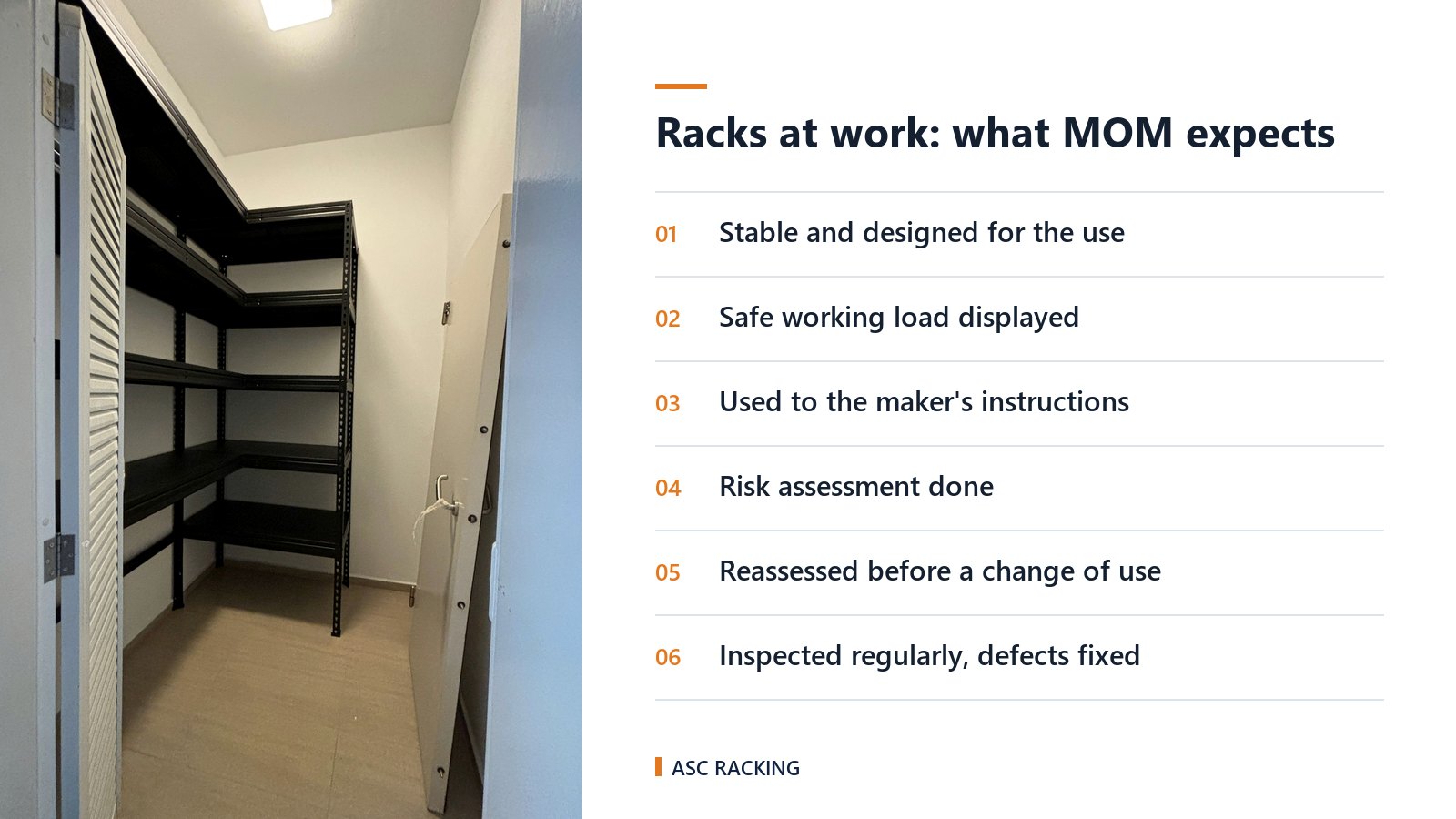
If staff use the rack, the type of joint matters less than how the rack is chosen, loaded and kept. MOM’s 2015 circular on the safe use of storage racks was issued after fatal rack collapses in warehouses, and it sets out what occupiers and employers should do. In summary, racks should:
- be structurally stable and designed for the intended use, including weight, size and environment;
- have their safe working load prominently displayed;
- be used according to the manufacturer’s instructions, with a risk assessment and safe work procedures;
- be reassessed before any change of use, including a change in the goods stored;
- be inspected regularly for damage or corrosion, with defective parts repaired or replaced before use.
None of that depends on whether the frame is bolted. Our warehouse racking safety guide turns them into a working inspection routine.
Choosing for your space
Ask how items will be loaded, by hand or by machine. Then work out the heaviest level once its load is spread out, and how often the layout is likely to change. If the answers are “by hand”, “within the rating” and “now and then”, boltless is the practical choice, and you can browse sizes and finishes in our storage rack shop. Our Full Metal 4-level rack is the usual starting point for storerooms and stockrooms, with depths of 300, 450 or 600 mm and heights from 1840 mm to 3000 mm.
If the answers point towards pallets, point loads or a tall fixed system, talk to a pallet racking specialist. If you are unsure which side of the line you are on, send us the room size and what you plan to store through our contact page, and we will tell you honestly whether shelving fits.
Frequently asked questions
Is boltless racking strong enough for a warehouse?
For hand-loaded shelving in a warehouse, yes, provided each level stays within its rated load spread across the shelf. Our Full Metal and PVC Laminate 4-level racks are rated at 300 kg per shelf. For pallets handled by forklift, use pallet racking designed for that purpose instead.
Can boltless racks be fixed to the wall?
They are designed to stand on their own, but tall racks in busy areas or racks loaded unevenly can be tied back to a wall for extra stability. Check what the wall is made of first, and in an HDB household shelter follow SCDF’s limits on drilling and fixtures.
Is slotted angle shelving the same as bolted racking?
It is one type of bolted racking. Slotted angle uses L-shaped steel sections joined with nuts and bolts at each corner. Bolted racking also includes bolted shelving units and heavy structural pallet racking, which are very different products.
Which is cheaper, boltless or bolted racking?
Slotted angle materials can cost less, but they take longer to build and change. Boltless racks usually win on total cost when you count installation time and every later reconfiguration. As of November 2026, ASC Racking’s single 4-level racks are listed from S$145 to S$400 depending on finish and size.
Can I add levels to a boltless rack later?
Yes. As long as the uprights are tall enough, you can add beams and shelf boards at any free slot height. Recheck the rating per level and keep heavier items on the lower shelves after the change.


