How can office archive shelving be organised for retrieval?
Give stored boxes or file groups clear references, record their contents and locations at an appropriate level, and agree how material is checked out and returned. Office archive shelving organisation should help an authorised person find the right record without opening unrelated boxes. Shelf capacity and the organisation’s retention and access requirements remain separate matters to confirm.
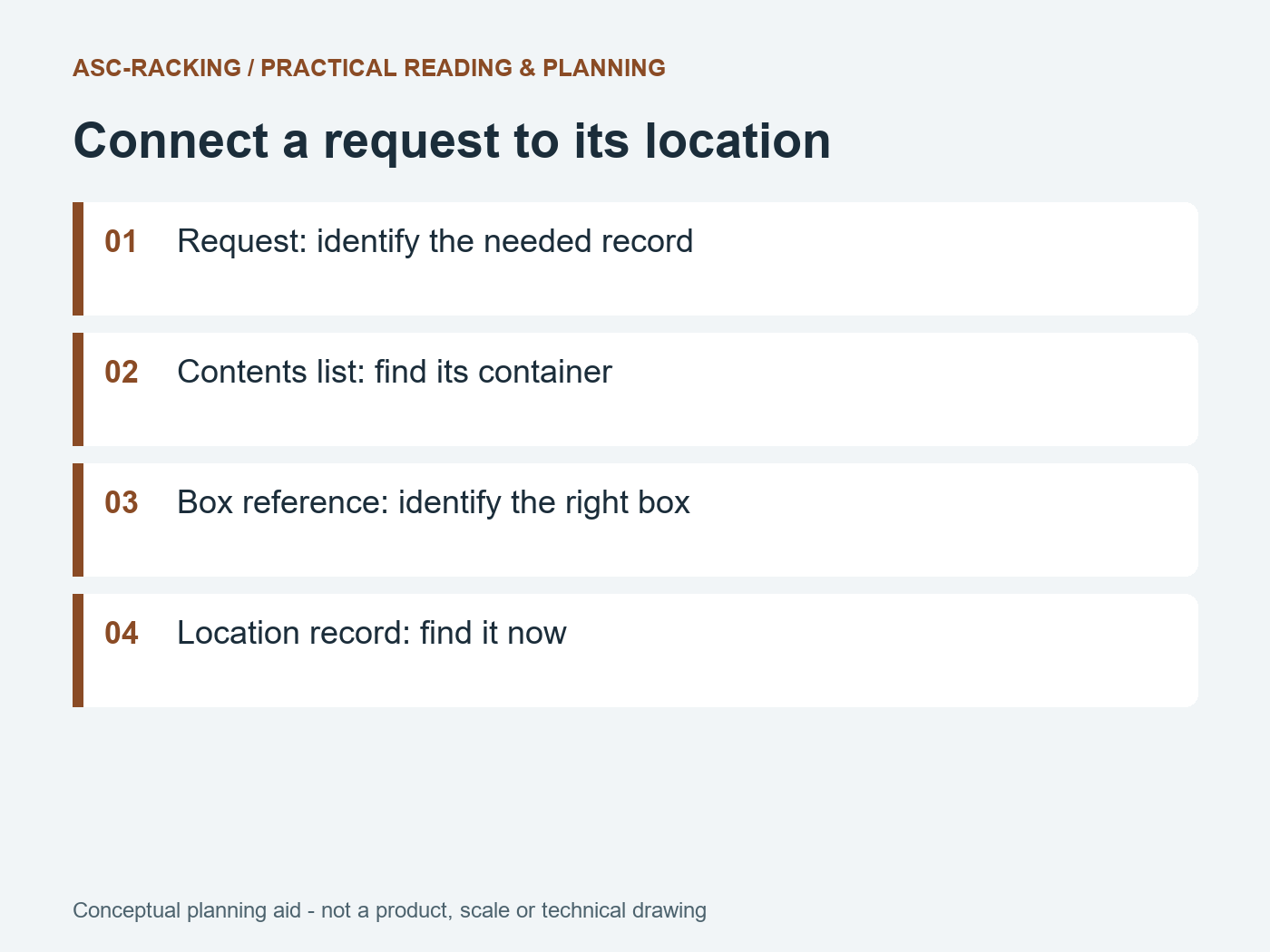
An archive can look tidy while being difficult to use. Similar boxes may contain different projects, and a label that says “old files” can conceal several years of unrelated material. The practical objective is to connect a retrieval request to a known location and a clear return process.
This is a physical organisation guide, not a records-retention policy, legal compliance assessment or shelving design. ASC Racking’s office and archive storage offering provides the shelving context. Your organisation determines which records need retaining, who may access them and how confidential information must be handled.
Define what the team needs to retrieve
Ask how a request normally arrives. Someone may know a project reference, a customer file number, a department or a date range. Choose a classification that connects those real requests to the stored material, rather than arranging boxes only by when they were packed.
Separate active working files from material used infrequently where that helps the workflow. This does not mean placing less-used boxes wherever there is a gap. They still need a recorded location and a way to be returned correctly.
| Retrieval question | Useful organisation decision | Problem it avoids |
|---|---|---|
| Which box holds the project? | Use a box reference linked to a contents description. | Opening several similar cartons to search for one file. |
| Where is that box now? | Record the current storage location. | Finding the contents list but not the physical material. |
| Has somebody taken it out? | Use an agreed checkout and return process. | Assuming a temporarily removed box has been lost. |
| Who may view it? | Apply the organisation’s access rules. | Exposing sensitive detail on an open shelf label. |
Give each container an identity that survives a move
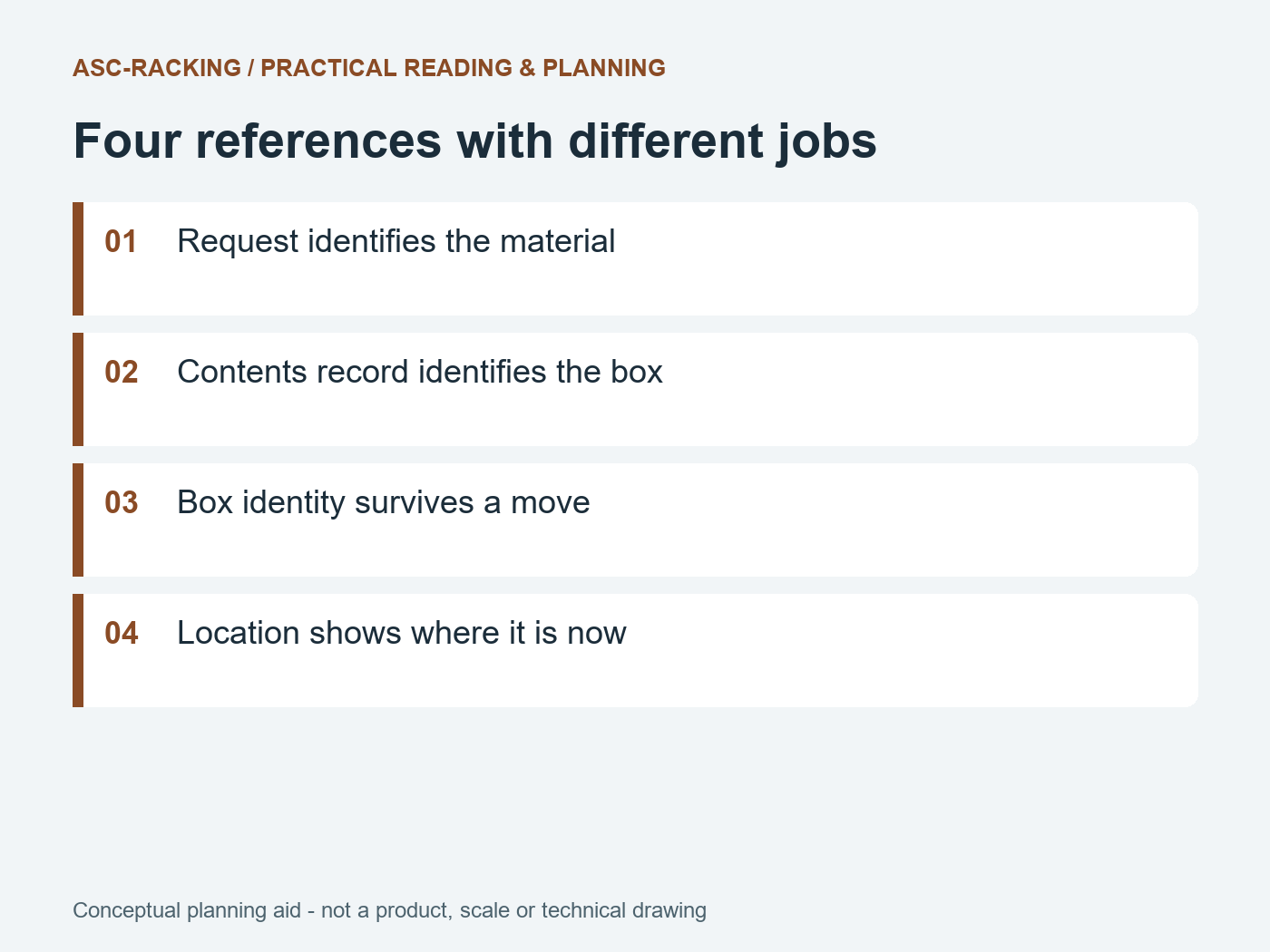
A box reference identifies the container; its shelf location tells you where it is currently stored. Keeping them separate means a location change need not break the link to the contents record.
For an educational example, “Archive Box A” could move from a first storage area to another agreed location. Its contents record should still identify the same box while showing the updated address. The example demonstrates the relationship, not a required naming format.
Avoid assigning the same reference to multiple active containers. If the team reuses a container or reference, agree how the old record is closed or updated. Otherwise an apparently precise label may point to the wrong material.
Keep the visible label appropriate for the space
A label needs enough information for an authorised user to identify the correct box, but it need not display private names or sensitive subject matter to everyone walking past. Decide what belongs on the container and what belongs in a controlled contents record.
Use consistent wording and a label position that can be read from the normal retrieval approach. Do not make access depend on moving unrelated boxes simply to see a reference. Test the arrangement with someone who did not pack the archive.
If a particular label attachment is being considered, follow the shelving and container instructions. An archive organisation exercise is not permission to drill into a rack, obscure safety information or alter the installation.
Plan the return before allowing the checkout
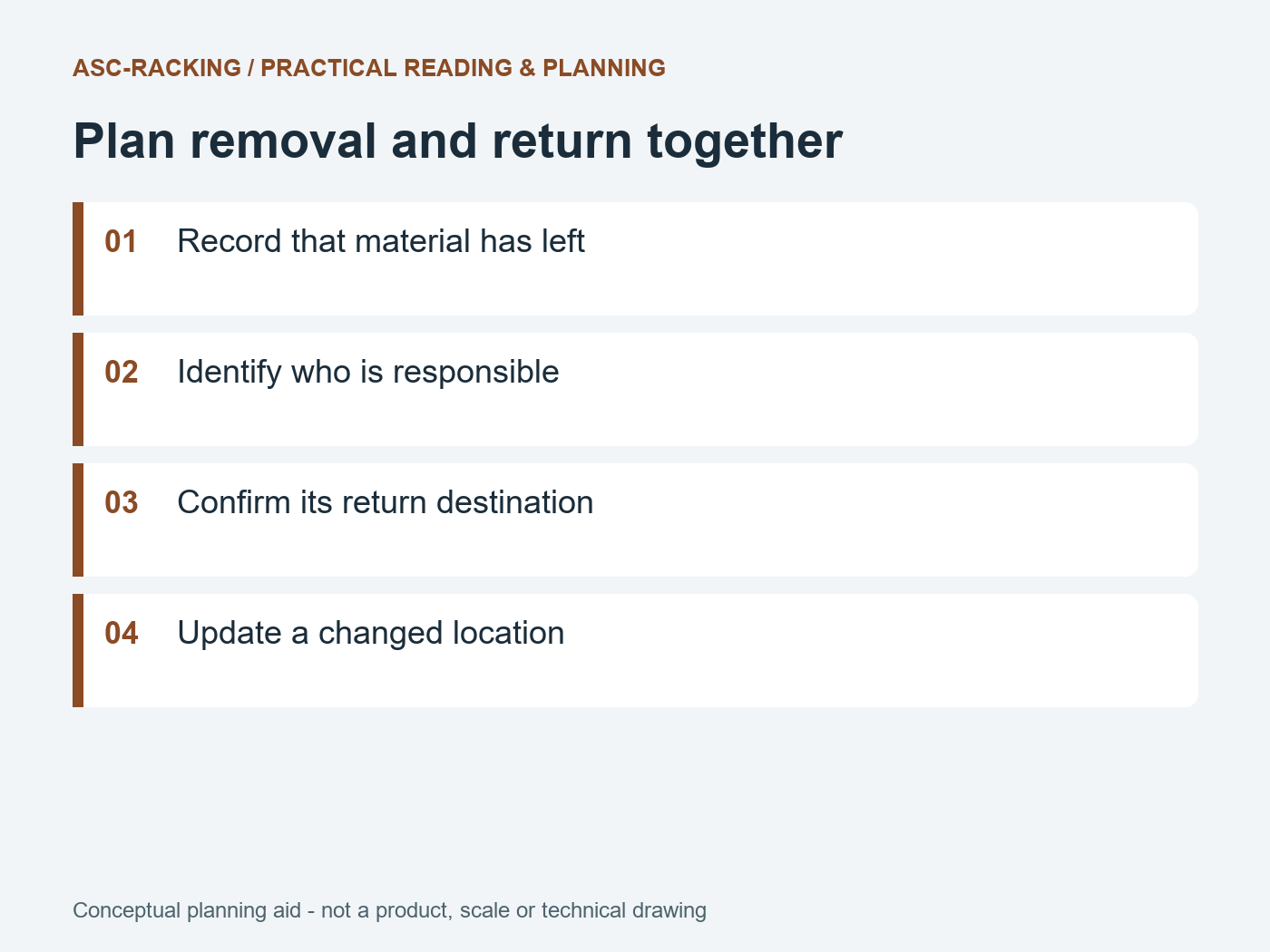
Agree how the team records that a box or file has left its usual place. A checkout note can explain who is responsible and how the item will return, using whatever process is appropriate for the organisation. A shelf should not silently become the only record of whether material exists.
Decide what happens if only part of a container is removed. Returning a different file to the wrong box can be harder to detect than an empty shelf position. The process needs to fit the level at which the team actually retrieves documents.
When a record is returned, confirm its destination rather than placing it in the nearest open space. If the allocation has changed, update the location record at the same time. A tidy temporary pile is still an unrecorded location unless the process recognises it.
Separate a records review from a shelving change
Review stored material under the organisation’s actual retention and disposal requirements. Do not adopt a universal number of years from a storage article or assume that an old date means a file may be discarded. The responsible person must determine the correct action.
Likewise, a box count is not a shelving specification. The size and weight of the actual containers, their permitted storage arrangement and access needs must be assessed for the system. Do not add levels, change beams or make a load assumption because the archive is growing.
ASC’s Full Metal rack category and PVC Laminated rack category describe available product families. Their names do not establish the suitability of an archive arrangement or a particular load. Confirm the actual shelving requirements separately.
Use a small retrieval trial before expanding
Choose a few representative requests and have an authorised colleague follow the proposed references. Check whether the contents description identifies the right material, whether the location is current and whether the return process is clear.
If the trial fails, identify the specific gap. The problem may be an overly broad contents description, a duplicate box reference, an unrecorded move or an unclear access decision. More elaborate labels will not solve all four problems.
The separate adjustable versus fixed shelving discussion concerns the physical storage choice. A retrieval trial evaluates how people will use and maintain the references within the agreed storage arrangement.
Office archive questions
Is organising boxes the same as setting a retention policy?
No. Physical references help find material. The organisation’s applicable retention, access and disposal requirements determine how that material should be managed.
Should private details appear on every label?
Not automatically. Decide what an authorised user needs to see on the box and what should remain in a controlled contents record.
What happens when a box changes shelf?
Keep the box identity linked to its contents and update the location record. The move should not depend on someone remembering the new position.
Can a growing archive simply use higher shelves?
Do not assume a different physical arrangement is suitable. Review the actual containers, shelving specifications and access requirements with the appropriate responsible party.

