
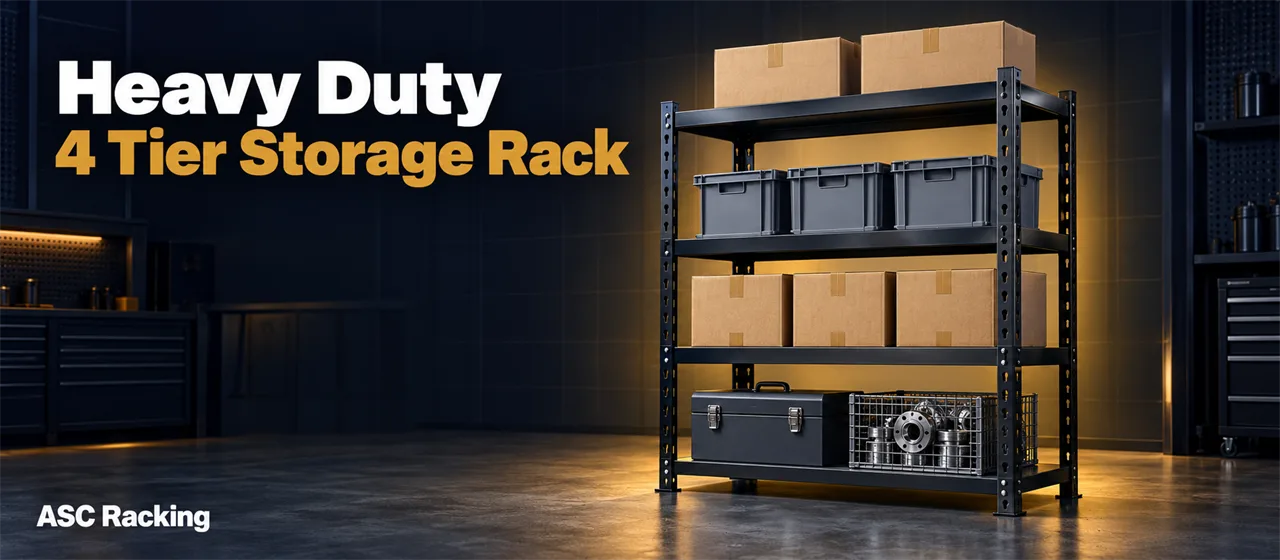
A heavy duty 4 tier storage rack is a boltless shelving unit with four levels that are each rated to carry a heavy, evenly spread load. It suits cartons, tools, spare parts and bulk supplies in warehouses, workshops, shop backrooms and HDB storerooms. This guide explains what “heavy duty” actually means on a rack, how to read a per-shelf rating, which shelf finish to pick for heavy items, how to load it safely, and when you need a different system altogether.
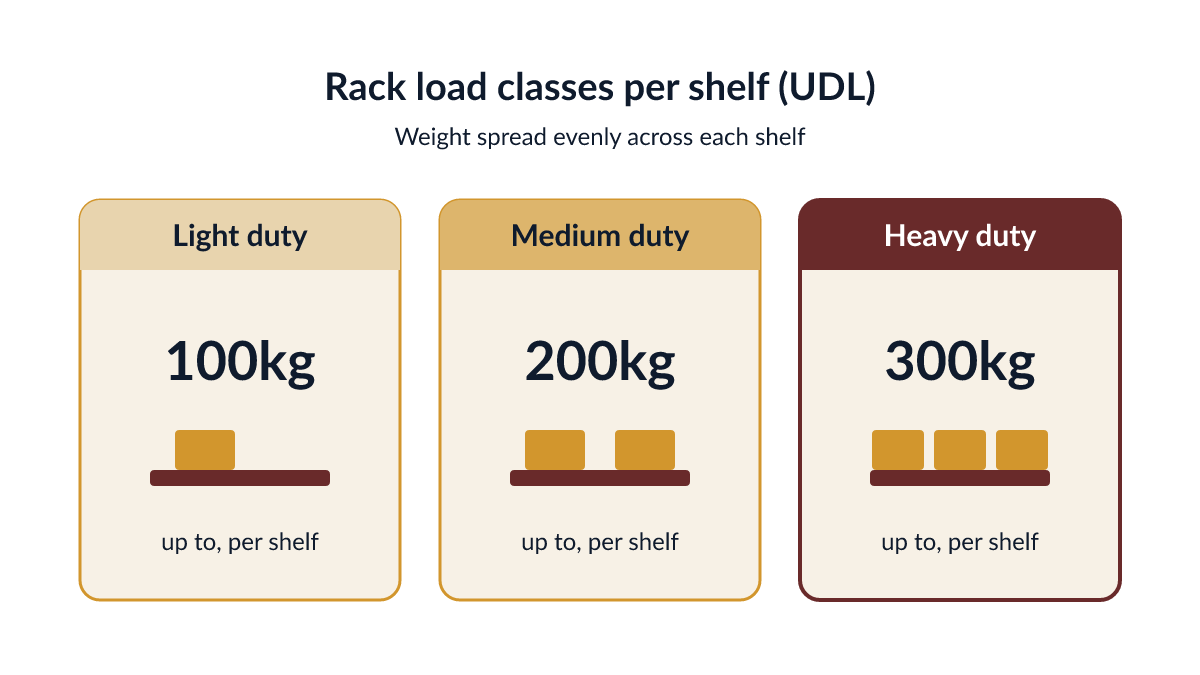
A heavy duty 4 tier storage rack holds a heavy load on each of its four levels. ASC Racking rates its heavy duty boltless racks at up to 300kg per shelf, spread evenly (UDL), against 200kg for medium duty and 100kg for light duty. It suits goods loaded by hand. Palletised goods moved by forklift need pallet racking instead.
What makes a 4 tier storage rack heavy duty?
“Heavy duty” is not a style or a colour. It is a load class: how much weight each shelf can carry when the weight is spread across it. Racks that look alike can sit in very different classes, so the rating is the first thing to check.
ASC Racking groups its boltless racks into three classes, stated per shelf as a uniformly distributed load (UDL):
- Light duty: up to 100kg UDL per shelf.
- Medium duty: up to 200kg UDL per shelf.
- Heavy duty: up to 300kg UDL per shelf.
ASC lists both of its single 4-level racks, the Full Metal (4 Levels) rack and the PVC Laminate (4 Levels) rack, at 300kg per shelf, which puts them in the heavy duty class. For loads beyond that, ASC states that it offers custom solutions.
What 300kg per shelf means in practice
A per-shelf rating is easy to misread. Three points matter when you plan what goes on the rack.
It is a figure for each level
The 300kg rating applies to each shelf on its own. It does not mean you can take the weight of two levels and pile it onto one. Work out the heaviest thing each level will hold and check that level against the rating.
It assumes the weight is spread evenly
UDL means the load is spread across the whole shelf. A single heavy item sitting in the middle of a long shelf puts much more strain on that one spot than the same weight laid out in a row of cartons. If you store dense items such as metal parts, tins or boxed tiles, spread them out or put them on a lower level.
It assumes the rack is standing properly
The rating only holds for a rack that is upright, square, on a level floor and fully assembled. A bent beam or a shelf that is not seated properly lowers what the rack can safely carry, so fix those before you load it again.
Full metal or PVC laminate shelves for heavy loads
Both of ASC’s 4-level racks use the same boltless frame and the same 300kg per shelf rating. The difference is the shelf surface, and that matters for what you store.
| Feature | Full Metal (4 Levels) | PVC Laminate (4 Levels) |
|---|---|---|
| Shelf surface | Heavy-duty metal with epoxy powder coating | PVC laminated 9mm HDF board |
| Rated load | 300kg per shelf | 300kg per shelf |
| Better for | Tools, spare parts, metal items, stock that is dragged on and off | Files, boxed goods and supplies where a smooth, easy-to-clean board helps |
For a warehouse, workshop or garage where heavy or rough items slide on and off the shelves, full metal is usually the more practical choice, because scuffs and knocks matter less on a metal surface. PVC laminate suits offices, storerooms and shop backrooms where the rack is on show and needs to be wiped clean. ASC states that its racks have an epoxy powder coating for rust and corrosion resistance, which helps in Singapore’s humid storerooms and kitchens. For a fuller comparison, see PVC laminate vs full metal storage racking.
How to load a heavy duty rack safely
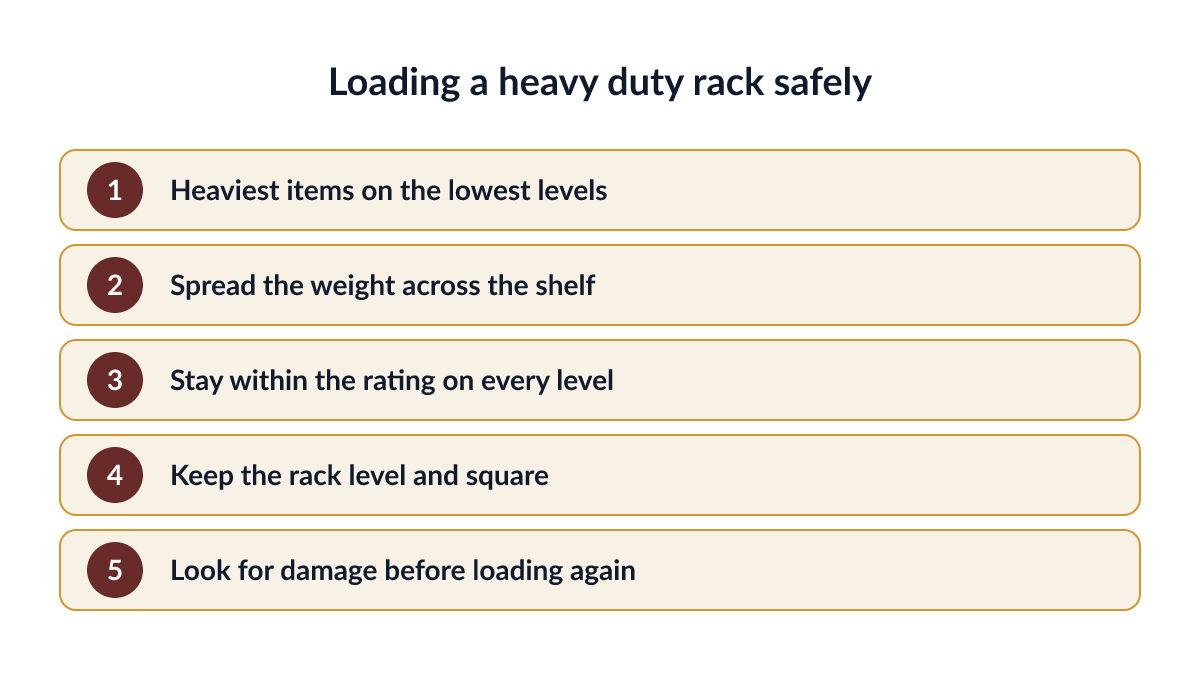
A heavy duty rating gives you headroom, not permission to stop thinking about how the rack is loaded. These five habits keep a 4 tier rack stable and within its rating:
- Heaviest items on the lowest levels. A low centre of gravity keeps the rack steady, and heavy items are safer to lift from near the floor.
- Spread the weight. Lay items across the full shelf rather than stacking them in one spot.
- Stay within the rating on every level. If you are unsure what a shelf is holding, weigh one full box and count the boxes.
- Keep the rack level and square. Check it stands evenly after it is moved or after you change a level.
- Look for damage. Check now and then for bent beams, loose shelves or damaged uprights, and fix them before loading again.
Our rack loading and inspection guide goes into safe loading and inspection in more detail.
Where a heavy duty 4 tier rack works, and where it does not
A heavy duty 4 tier storage rack is built for goods that people place and pick by hand. Common places for one include:
- Warehouses: cartons, bins and hand-picked stock along the walls or in short runs.
- Workshops: tools, machine parts and consumables, with the heaviest items on the bottom level.
- Retail backrooms: boxed stock that needs to be found and moved quickly.
- Offices: archive boxes, paper and equipment.
- HDB and condo storerooms: ASC designs its 4-level racks to fit HDB flats and condo units, so heavy household items, luggage and bulk supplies can go up instead of across the floor.
It is the wrong tool when your goods sit on pallets and are moved by forklift. Pallet loads need pallet racking, which is a different system designed for that kind of handling. If your heaviest single items are beyond a per-shelf rating even when spread out, ask the supplier about a custom solution rather than overloading a standard rack.
Single, L-shaped or U-shaped layouts
A single 4 tier rack follows one wall. In a storeroom or workshop corner, two racks joined at a right angle use space that a single rack leaves empty. ASC offers this as the Full Metal L-Shaped (4 x 4 Levels) rack. For a small room where you want shelving on three walls, the Full Metal U-Shaped (4 x 4 x 4 Levels) rack wraps around the space.
Whichever layout you choose, leave a clear path to every level. A heavy item on a shelf you cannot reach safely is a risk, not storage.
Setting it up and changing it later
A boltless rack goes together without nuts or bolts: the beams slot into the uprights and the shelves rest on the beams. ASC states that its 4-level rack can be assembled in about 15 minutes without tools, and its product pages state that professional installation is included in the price.
The same design helps after the rack is in use. When your stock changes, you can unload a shelf, lift the beams out and move that level up or down to fit taller or shorter items. Check the rack is level and square before you load it again. For more on why movable levels are useful, see adjustable vs fixed shelving.
Checks before you order
Run through these before you choose a heavy duty rack:
- The heaviest load per level. Check it against the per-shelf rating, not the total for the rack.
- How items are handled. By hand suits a boltless rack. Pallets and forklifts need pallet racking.
- The shelf surface. Full metal for rough or heavy items, PVC laminate for a clean, wipeable finish.
- The space. Wall length, ceiling height, door swing and walkway width.
- The layout. One wall, a corner or three walls.
For the heights, lengths, depths and current prices of ASC’s 4-level racks, see the 4-tier boltless rack sizes and prices guide.
Frequently asked questions
How much weight can a heavy duty 4 tier storage rack hold?
ASC Racking rates its heavy duty boltless racks at up to 300kg per shelf, spread evenly (UDL). That applies to both its Full Metal (4 Levels) and PVC Laminate (4 Levels) racks. It is a rating for each level, so keep every shelf within it, put the heaviest items low and spread the weight across the shelf.
What is the difference between light, medium and heavy duty racks?
The difference is how much weight each shelf is rated to carry. ASC states light duty racks hold up to 100kg UDL per shelf, medium duty up to 200kg and heavy duty up to 300kg. Choose the class by the heaviest load a single level will carry, not by how the rack looks.
What does UDL mean on a storage rack?
UDL stands for uniformly distributed load. It means the rated weight is spread evenly across the whole shelf. A single heavy item in the middle of a long shelf strains that spot far more than the same weight spread out, so lay dense items across the shelf or move them to a lower level.
Is a heavy duty 4 tier rack suitable for a warehouse?
Yes, for goods that people place and pick by hand, such as cartons, bins, tools and spare parts. It is not a substitute for pallet racking. If your stock sits on pallets and is moved by forklift, you need pallet racking, which is a different system built for that handling.
Should I choose full metal or PVC laminate shelves for heavy items?
Both of ASC's 4-level racks carry the same 300kg per shelf rating. Full metal usually suits tools, parts and rough stock dragged on and off the shelves in warehouses and workshops. PVC laminated 9mm HDF board suits offices and storerooms where a smooth, easy-to-clean surface matters.
Choosing your heavy duty 4 tier storage rack
A heavy duty 4 tier storage rack is the right choice when you store heavy goods by hand and want four adjustable levels in one footprint. Check the per-shelf rating against your heaviest level, keep that weight spread and low, pick full metal or PVC laminate by what you store, and choose pallet racking instead if your goods move on pallets. Get those points right and the rack will carry what you need, level by level.


